The House Appropriations Committee provides financial support for the Medicaid program, the largest health care financing program for low-income, aged and disabled persons in Virginia.
Medicaid is jointly financed by the state and the federal government and administered within broad federal rules. Medicaid provides a comprehensive health benefits package to low-income families with children, adults, aged, blind and disabled persons. Medicaid is administered by the Department of Medical Assistance Services (DMAS), along with other health care financing programs.
Budget Overview
Medicaid eligibility has expanded from its inception in 1965 when it was linked to two legacy federal public assistance programs, Aid to Families with Dependent Children and Supplemental Security Income (SSI) for low-income aged, blind and disabled persons. Federal mandates over the years expanded eligibility to more low-income groups such as indigent pregnant women, children in families with incomes up to 133% of the federal poverty level (FPL) and certain low-income Medicare beneficiaries. With the passage of the federal Affordable Care Act (ACA) in 2010, states were given the option to expand Medicaid eligibility to serve more low-income individuals with incomes up to 138% of the FPL. Virginia expanded Medicaid eligibility on January 1, 2019.
States are guaranteed federal matching dollars without a cap for qualified services provided to eligible enrollees. The federal match rate for most Medicaid enrollees is determined by a formula in the law that provides a match of at least 50% and provides a higher federal match rate for states with lower per capita income. States may receive a higher match rate for certain services and populations. Virginia’s match rate for the base Medicaid program is currently about 50%. The federal Children’s Health Insurance Program (Title XXI of the Social Security Act, enacted in 1997) increased the federal match rate to 65% for children in families with incomes between 100% to 133% of the FPL, comparable to the match rate for children covered by the CHIP program (family incomes between 133% and 200% of the FPL). The ACA Medicaid expansion group is financed with a 90% federal match rate, with a 10% state match. In Virginia, the state share for the Medicaid expansion group is paid through a provider tax on 63 acute care hospitals not to exceed 6% of net patient revenues. Recent federal legislation (H.R.1 – 119th Congress (2025-2026)) will reduce this percentage cap by 0.5% annually beginning October 1, 2027.
Medicaid comprises 28% of the state budget, 79% of all funds for the Health and Human Resources budget and 97% of the DMAS budget.

Medicaid enrollment grew significantly over the past eight years primarily due to the adoption of ACA Medicaid expansion in FY 2019 and the onset of the COVID-19 Public Health Emergency (PHE). States were required to maintain Medicaid eligibility for individuals who became enrolled in the Medicaid program during the PHE, in order to receive enhanced federal funding. Virginia began redetermining eligibility for the program in April 2023 which continued through FY 2024.
Medicaid annual expenditures also grew significantly during this same period.
MEDICAID: THREE MAIN COST DRIVERS
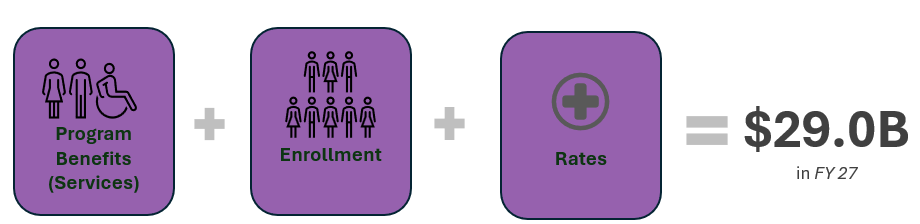
Medicaid enrollment, benefits and rates for services drive the cost of the program. Typically, Medicaid enrollment is the primary driver of the cost of the program. However, utilization of services by enrollees contributes significantly to the costs and can vary by the age, disability, and health of the enrollee.
Private managed care organizations (MCOs) are insurance companies that coordinate the care of almost 90% of the enrolled Medicaid members. These MCOs are paid a monthly capitated rate for every enrolled member. The capitated payment is based on actuarial analysis that is conducted annually and generally assumes a 1% profit. The Virginia Medicaid program officially launched the newly procured Cardinal Care Managed Care program on July 1, 2025, which transitioned 1.7 million members into the program, served by 5 private managed care plans:
- Aetna Medicaid Virginia
- Anthem
- Humana Healthy Horizons
- Sentara Health Plans
- UnitedHealthcare Community Plan
Besides MCOs, Medicaid makes claims payments directly to hospitals, nursing facilities, community services boards, local health department clinics, federally qualified health clinics, and local social services offices on behalf of Medicaid enrollees.
Program/Policy Highlights
- Medicaid Forecast
Each November, the Departments of Planning and Budget and Medical Assistance Services complete a 3-year consensus forecast of Medicaid expenditures for the current fiscal year and the next biennial budget. The forecast is adjusted for policy decisions that were adopted through General Assembly actions and updates to managed care rates, and trends in enrollment, utilization and benefit costs.
- Major Medicaid Funding and Policy Changes for the 2026-2027 Biennium
Provided $2.8 billion for Medicaid and CHIP reforecasts, to back fill revenue declines from the Virginia Health Care Fund, and protect against higher than forecasted Medicaid utilization
Reserved $350 million in state general funds in a Medicaid contingency fund to address federal changes and impacts on the Medicaid forecast
Added $81.8 million in state general funds to increase Medicaid developmental disability (DD) waiver service rates for DD waiver services over the biennium
Added $44.3 million in state general funds in FY 2028 to increase Medicaid personal care rates
Added $35 million in state general funds in FY 2027 to support nursing homes in hiring additional staff and improving the quality of care
Additional policy and funding changes included restoring proposed cuts to the FAMIS program for prenatal and postpartum services, adding Medicaid coverage for Sickle Cell Disease treatment, and restoring funding to preserve applied behavioral analysis services for children age 5 and younger
Resources and Deep Dives
Staff Contact
